
The QR boom in India
Someone sent me a short NBC News report from 2023 and I keep coming back to it: QR codes boom in India. Two and a half minutes about food stalls and small vendors, and how a QR code changed the way they take money. No terminal, no card reader, no contract with a payment provider. A printed code at the stall, the customer scans it with their own phone, and the money lands in the vendor’s own account.
That is our cash register, three years earlier, at a scale nobody in Europe comes close to.
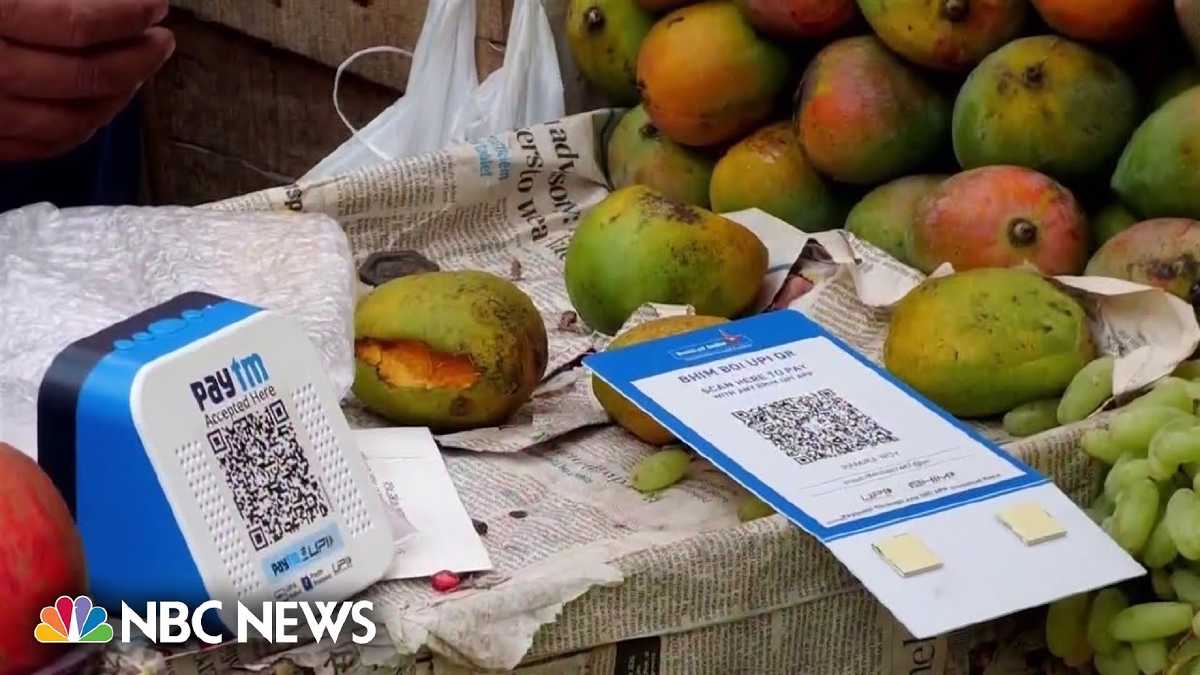 A fruit stall in India: a printed UPI QR code next to the mangoes, no card reader in sight (still from the NBC News report)
So people will scan
I wrote last month about Zahlo, who ran 30,000 euros through EPC QR codes in Germany and found that their buyers hated it. Scanning, checking, confirming: four steps where tapping a card is one.
But India is the counter-example, and it is not a small one. UPI, the Indian equivalent of an account-to-account QR payment, now handles well over 22 billion transactions a month, spread across more than 65 million merchants. Roughly two thirds of that volume is person-to-merchant, and the overwhelming majority of those payments are tiny: the equivalent of a few euros, at a market stall, for a cup of tea.
So the objection is not that scanning is too much work. Hundreds of millions of people do it dozens of times a month, for amounts a European would not even get their card out for. The objection is that scanning is unfamiliar. Those are two very different problems, and only one of them is permanent. Payconiq in Belgium and Vipps in Scandinavia already showed the same thing on a smaller scale (and closer to home).
And then the toll arrives
Here is the part of the story that was not in the 2023 report.
From 15 October 2026, India starts charging merchants for UPI payments. The NPCI has set a merchant discount rate of 0.4% on payments to merchants above 2,000 rupees, with a flat 5 rupees for some categories such as fuel, telecom and insurance, and a cap of 300 rupees on the largest payments. Payments up to 2,000 rupees stay free, and the NPCI points out that this covers some 96% of merchant transactions.
As a policy it is defensible. The rail cost somebody money to run, the fee lands mostly on large merchants, and the corner stall is untouched. But look at how the 0.4% is divided: 40% to the bank that holds the customer’s account, 30% to the merchant’s acquirer, 20% to the UPI app, and the remainder to that app’s banking partner.
Why the EPC QR will not go into the same direction
The EPC QR behind our cash register is not a rail and nobody owns it. It is a plain SEPA credit transfer from one bank account to another, and the QR code is nothing more than a way of typing in the IBAN and the amount without typos. There is no acquirer. There is no app in the middle. There is no scheme operator who can publish a rate card next year.
Not because we are nobler than the NPCI, but because the chain is empty. There is no one to divide 40/30/20 between.
What I take from it
- The behaviour is learnable, and India proves it at a scale of hundreds of millions of people.
- The hardware question is settled: for the smallest merchants, terminal costs are a barrier.
- Zero commission only holds if there is nobody in the path who needs to be paid. That is a property of the design, not a promise in a marketing message.
India spent ten years teaching a billion people to scan. We can skip that part: every European bank already sends and receives SEPA transfers. All that is missing is the habit. You can start today.
