
EPC and IBAN QR are now the standard
From today you can start with showing an EPC QR at checkout. The payment links you added yourself are still right behind it, in the same drop-down menu as always. So you do not have to change anything about the way you work, but you do gain an option. And what an option!
What is an EPC QR?
An EPC QR is not a payment link. There is no third party in between: the code simply contains your name, your IBAN, the amount and a description. Your customer scans it with their banking app, sees the transfer already filled in and only has to confirm it. The money goes straight from their account to yours. No payment provider, no intermediary account, no percentage, no data passing by anywhere else. It is a European standard, so in principle it works throughout the eurozone.
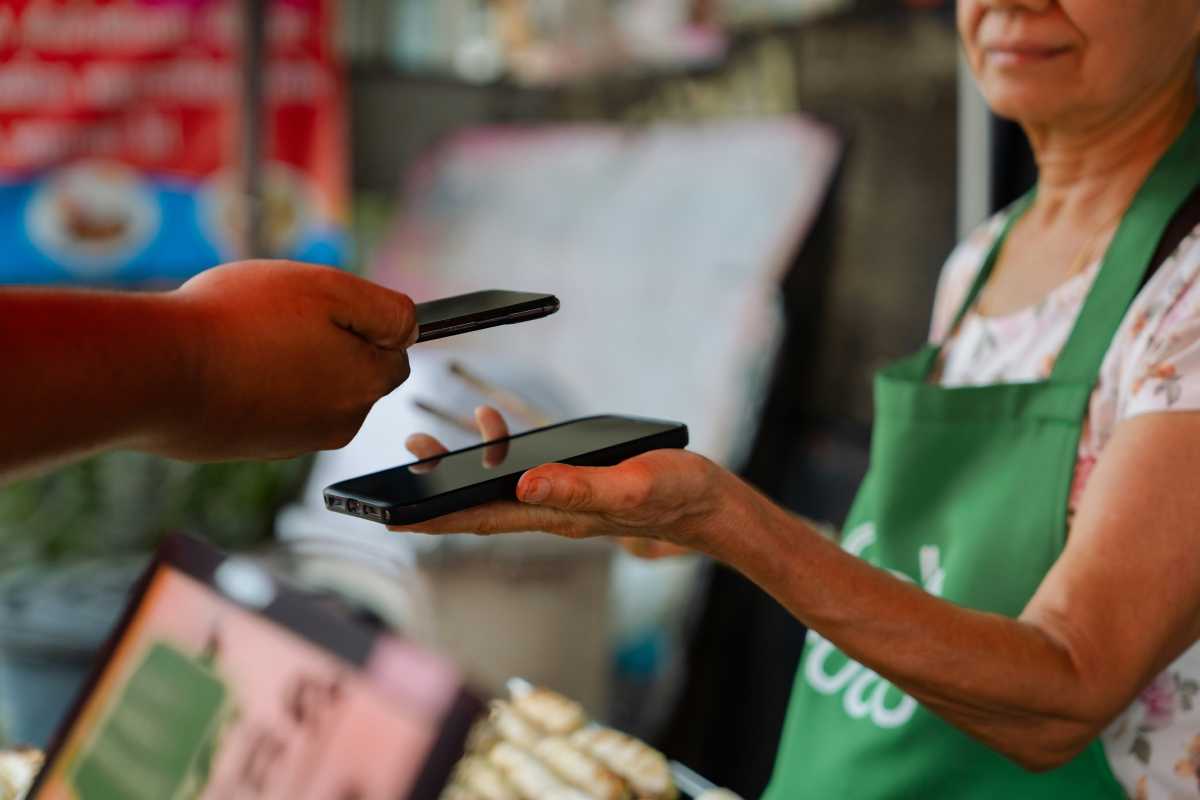 A phone is all it takes: the money goes straight from one account to the other
What I like best is what is no longer needed. An EPC QR does not expire, has no maximum amount and no maximum number of uses. So you never have to create a new payment link halfway through the day because the old one has run out. You enter your IBAN once under ‘Settings’, in ‘Company profile’, and from then on the code is always there, for any amount. Because it is an ordinary SEPA transfer, the amount is often in your account within seconds and your own bank can send you a push notification as soon as it arrives.
EPC QR support
Usecue POS comes from the Netherlands, so let me start close to home — and be honest, because that belongs here too: not every Dutch banking app can read this code. ING, bunq, Knab, ASN and SNS can. Rabobank, ABN AMRO and Triodos (together a considerable part of the market) do not support the standard yet. That is a pity and, as far as I am concerned, hard to understand, because it is the same standard that has been completely normal in Germany, Austria and Belgium for years.
To put that difference in perspective, below are the countries where the EPC QR has really caught on. The coverage percentages are estimates, based on the combined market share of the banks that support the standard:
- Germany: 80% — the highest adoption, grown big through the Sparkassen and the Volksbanken, and Commerzbank and Deutsche Bank take part as well.
- Belgium: 80% — just as good as Germany: virtually every large retail bank can do it, including KBC, Belfius, BNP Paribas Fortis and ING Belgium.
- Austria: 70% — this is where it started, under the name GiroCode, and by now it is in many banking apps.
- Finland: 70% — high adoption, with a lot of mobile banking and QR codes that are completely normal there.
- The Netherlands: 40% — the laggard. ING, bunq, Knab, ASN, SNS and RegioBank do support it; Rabobank and ABN AMRO, together some 60% of the market, do not. That is why we need the ‘manual’ payment links as a fallback.
And because that 40% is precisely the Dutch problem, you do not have to put the EPC QR first. You can give the EPC QR a higher priority number, exactly as with the other payment links. Your own payment link then appears first and the EPC QR sits behind it, in the drop-down menu. For a Dutch shop with many Rabobank and ABN AMRO customers that is probably the most practical setting; in Germany or Belgium I would show it first instead.
An IBAN QR as a fallback
And perhaps you do not need expiring payment links at all… because at the bottom of that same drop-down menu there is now one more option: ‘IBAN’. It shows a QR code containing only your account number, with your IBAN plainly readable underneath. If your customer’s banking app cannot read the EPC QR, they scan the IBAN QR code, select copy and paste the account number into their own banking app… or they type it over if they are less handy. That works with every bank, in every country, without a single intermediary. And for a repeat purchase? Then they can simply use their address book and type over the amount.
The only customer you do not serve this way is the one without a phone, and for them Tap to pay via Stripe remains a fine backup. So you never miss a single customer.
Opportunities for Usecue POS
The broad support for EPC QR in the countries bordering the Netherlands offers great opportunities for Usecue POS. Combined with push notifications from your bank and a Stripe account for card payments, Usecue POS is the very best system for small entrepreneurs in countries such as Germany and the Benelux. You already have the hardware (your phone) and your transactions are commission-free. Stripe has no purchase costs and only charges commission for those few payments that are not SEPA payments.
SEPA payments are available to everyone within the EU. And when SEPA payments are also made very easy through an EPC QR code, that is a big plus compared to other methods and payment parties that charge commission. So: Germany, Belgium and Luxembourg, hold on tight. Here we come, all the way from the Netherlands!
Try it yourself
Curious? Try it yourself and find out which QR codes suit your business best.
