
The story of Zahlo
Every now and then you discover that someone else has had the same idea as you. In my case that someone is called Zahlo: a young payment company from Berlin that promises merchants a smarter checkout with lower payment costs. They are a European, VC-backed payment provider competing with Stripe and Adyen. They started out in Open Banking, for online merchants, and from there took a step towards the physical shop counter. And the technique they chose for that step was the account-to-account QR code. The very same EPC QR that is behind our cash register.
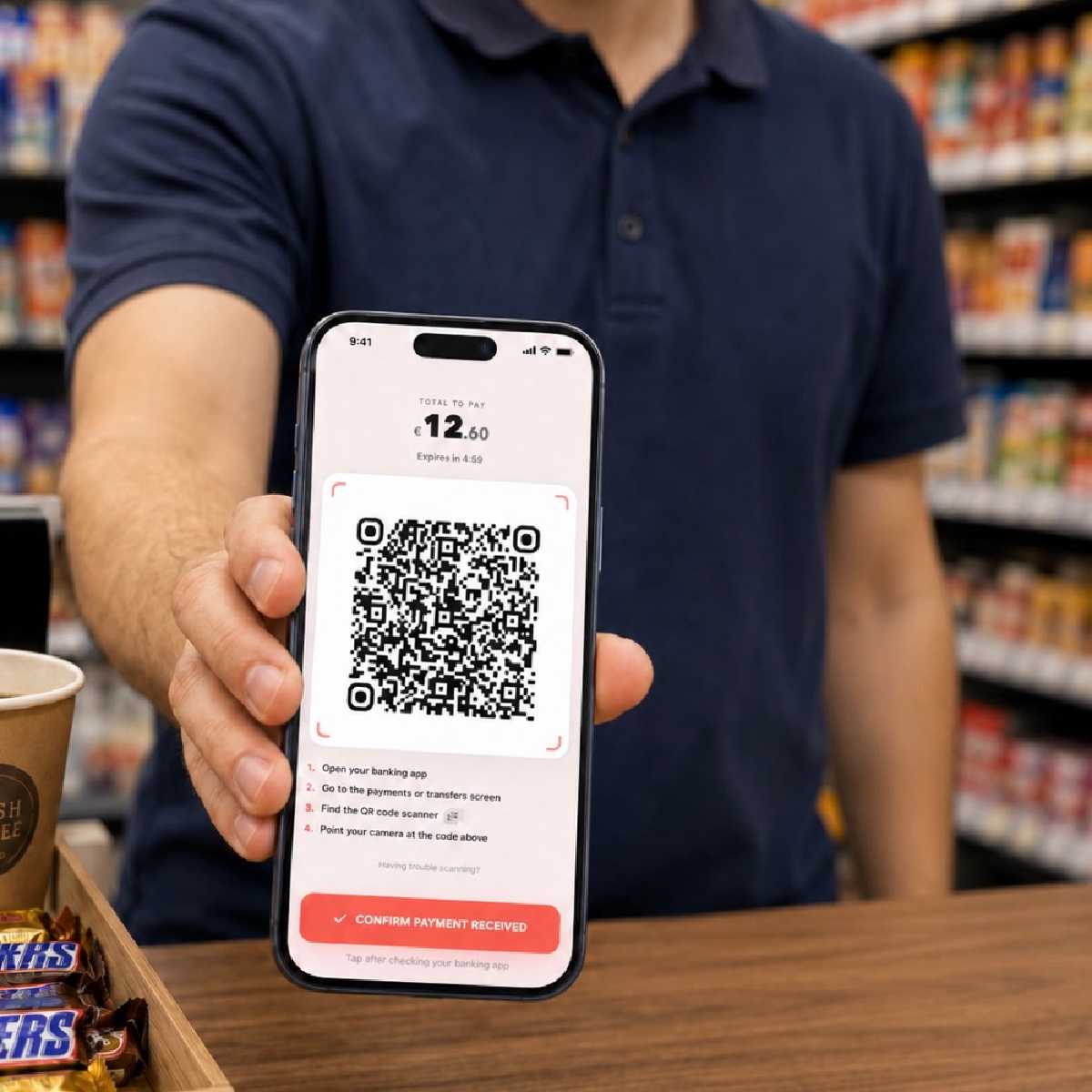 Zahlo’s checkout: the cashier shows the QR code and the customer scans it with their banking app
The same idea, the same words
Read what they write about it and you would think you were reading this blog: “The customer scans a code, the money moves account-to-account, and the card-network toll simply isn’t in the path.” And: “No card reader to buy either, because there’s no card being read.”
Their comparison is one I could have made myself: SumUp at 1.69%, Zettle at around 1.75%, Square at 1.75% for chip and contactless — and against that a QR code that costs nothing at all, with the money in your account in ten seconds thanks to SEPA Instant. For a German hairdresser with 10,000 euros a month in card turnover that is quickly more than 1,600 euros a year that stays in their own pocket. Exactly the sum I made for the sports canteen on the why page.
So: same analysis, same solution, same country in which it should work best. Germany has around 80% coverage for the EPC QR, far more than the Netherlands.
A 30.000 euro experiment
The interesting part is that they did not stop at the blog post: they actually ran it. They told me they processed around 30,000 euros through EPC QR codes. And it turned out that their buyers hated it.
That is a sentence worth sitting with for a moment, and I would rather write it down here myself than pretend I never heard it. Thirty thousand euros is not a demo and not a pilot with three friends. That is real turnover, from real customers, who apparently found scanning-and-confirming-in-your-own-banking-app more of a hassle than holding a card against a terminal. And I understand that, because tapping a card takes one second and involves no thinking, while an EPC QR asks the buyer to open their banking app, scan, check and confirm. That is four steps instead of one, and the payer bears all four.
They gave up
Not only because people disliked it, but also because it made little commercial sense for them. That is not sour grapes, it is arithmetic. Venture capital requires a return on investment at some point and there investor probably got cold feet.
Their pricing page now lists 1.00% + 0.05 euros on European consumer cards, rising to 3.25% + 0.05 outside Europe, plus 50 cents per payout and refund and 5 euros per chargeback. Even their own Open Banking is on that list, at 25 cents per payment. And the EPC QR? That is not on that list, because it cannot be. It is a plain SEPA transfer from one account to another, and there is no place in that chain where a payment company can sit and charge a fee.
Every payment they moved to the EPC QR was a payment they no longer earned anything on: thirty thousand euros of turnover, zero euros of revenue, plus support for a checkout buyers grumbled about.
Meanwhile the blog post promising 0% transaction fees is still online. That is not malicious, just out-dated marketing. Their name has the same problem. Read Zahlo the German way and it falls apart into ‘zahl 0’: pay zero. It is a great name, but it is weird to keep the name and give up on the principle behind it.
What I take away from it
I could shrug this off, but I would rather learn from it, so three honest lessons.
-
The buyer pays the price, not the merchant:
Most of the arguments for the EPC QR, no commission, no intermediary and no hardware, are arguments for the merchant. The person doing the extra work is the buyer, and they get little in return. -
Fallbacks are essential:
Precisely because of this we do not put the EPC QR first everywhere. You set the priority yourself, your own payment links stay in the same drop-down menu, there is an IBAN QR underneath for banks that cannot read the standard, and for the customer who does not want any of it there is still Tap to pay via Stripe. A buyer not wanting to scan is not a lost sale. -
Zero commission is not a revenue model:
This is the heart of the story. EPC QR made little commercial sense to the people behind Zahlo (employees and venture capitalists). With me that conflict of interest does not exist. I earn my living another way and I do not care about ROI. I care about privacy and giving power back to the people.
Still going ahead
Does this make me pessimistic? Not really. Payconiq was a success in Belgium, Vipps became popular in Scandinavia with exactly this scanning behaviour, and in Germany and Austria the GiroCode has been perfectly normal for years. So the behaviour can be learned.
Zahlo showed two things: that you cannot force it on a merchant in one go, and that a payment company has every reason to stop trying. The first is why we offer the QR code as one option among several instead of as the only way to pay. The second is exactly why this has to come from someone who does not live off your transactions.
So thank you, Zahlo, for the 30,000 euros worth of experience. I will make sure it does not go to waste.
